Materials and Design
Large Format Tile vs. Subway Tile: Which Is Better for Your Kitchen?
Large format tile and subway tile can both create a polished kitchen backsplash, but they produce very different results. This guide compares cost factors, installation complexity, grout lines, visual impact, maintenance, and best-use cases so homeowners can choose the right fit.
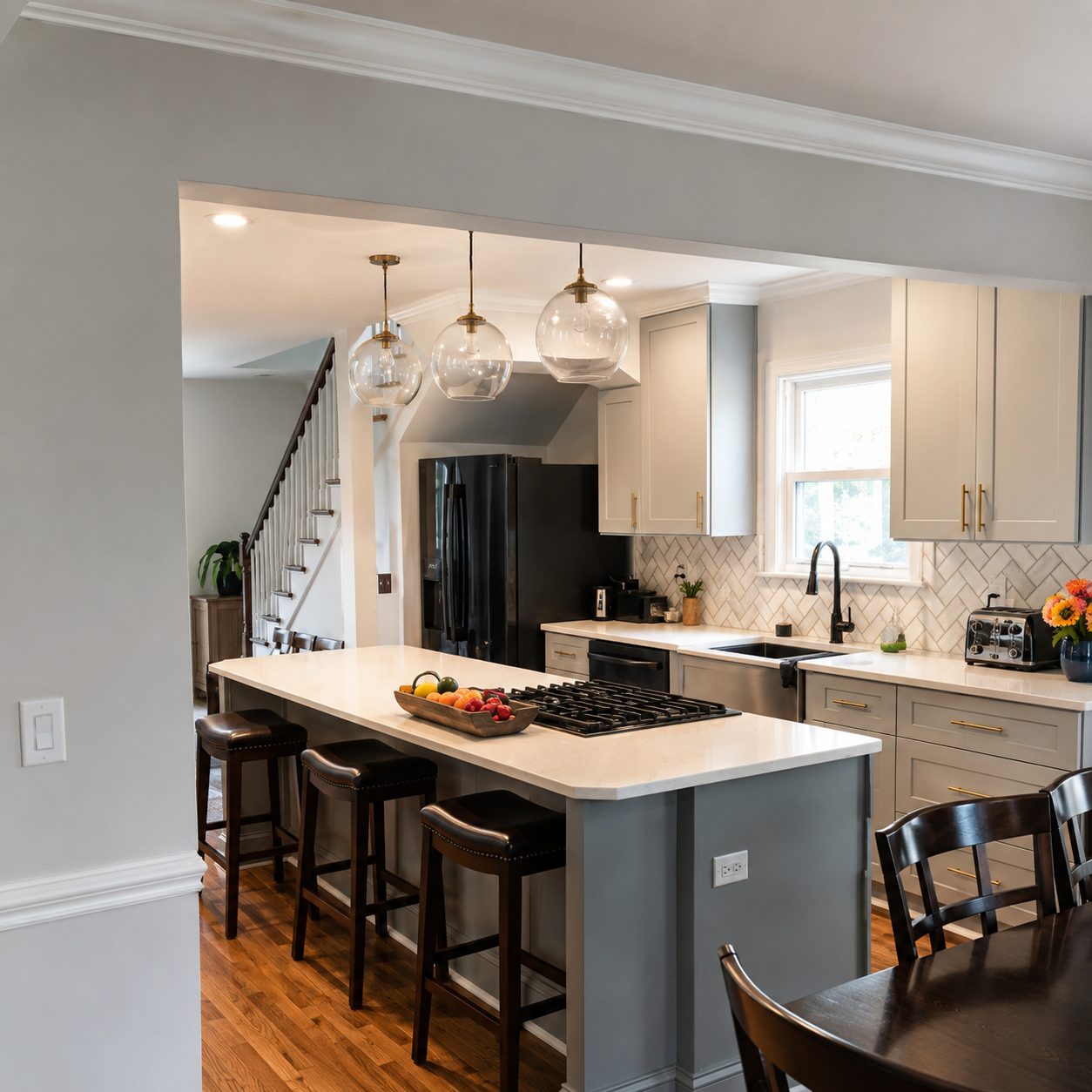
Large format tile and subway tile can both work beautifully in a kitchen, but they create very different results.
Subway tile usually feels classic, familiar, and versatile. Large format tile usually feels cleaner, more minimal, and more architectural. One gives the backsplash more pattern and rhythm. The other creates a quieter surface with fewer grout lines.
The better choice depends on the kitchen style, budget, material, layout, maintenance expectations, and the level of finish the homeowner wants.
For Charlotte-area homeowners planning a backsplash upgrade, the decision should not be based only on a photo. Tile scale changes the way the kitchen feels. It also affects installation complexity, cuts, grout visibility, wall preparation, and the final project scope.
The Main Difference Comes Down to Scale
Subway tile is smaller and more repetitive.
Large format tile is larger and more continuous.
That difference affects almost everything about the final backsplash.
Subway tile creates a visible pattern across the wall. The grout lines become part of the design, whether they are subtle or high contrast. It can feel classic, detailed, warm, or traditional depending on the tile, layout, and grout color.
Large format tile reduces the number of grout lines. It creates a cleaner visual surface and often feels more modern or premium. Instead of many small pieces, the backsplash reads as larger planes of material.
Neither approach is automatically better. They simply do different things.
A kitchen that needs texture, rhythm, or classic detail may work better with subway tile. A kitchen that needs calm, simplicity, or a more seamless look may work better with large format tile.
What Counts as Subway Tile?
Subway tile usually refers to rectangular tile installed in a repeated pattern.
The classic size is often associated with a horizontal running bond layout, but subway tile now comes in many sizes, finishes, and styles.
Subway tile can be:
- Glossy or matte
- Smooth or textured
- Handmade-look or machine-made
- White, neutral, dark, or colored
- Ceramic, porcelain, glass, marble, or stone
- Installed horizontally or vertically
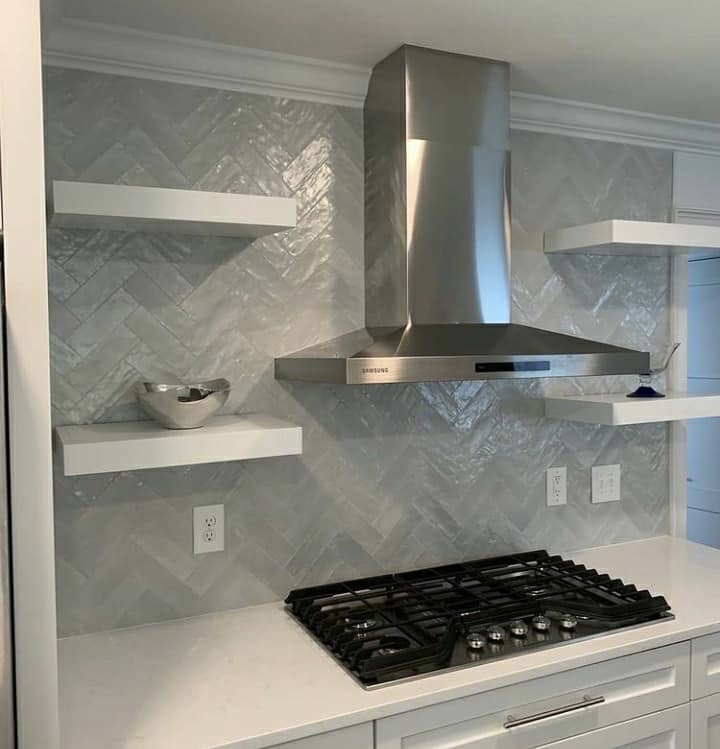
- Installed in running bond, straight stack, vertical stack, herringbone, or other layouts
This flexibility is one reason subway tile remains popular. It can support a traditional kitchen, transitional kitchen, modern kitchen, farmhouse-inspired kitchen, or builder-grade kitchen upgrade.
The final look depends less on the name subway tile and more on the tile finish, layout, grout color, and installation detail.
What Counts as Large Format Tile?
Large format tile refers to tile that is larger than traditional backsplash tile.
In a backsplash, this may include larger rectangular tiles, oversized porcelain pieces, marble-look porcelain, large stone-look tiles, or panels designed to create a cleaner surface with fewer grout joints.
Large format tile can be used for:
- Full-height backsplashes
- Range-wall features
- Modern kitchens
- Marble-look designs
- Minimalist kitchens
- Transitional kitchens with cleaner lines
- Slab-style backsplash looks
Large format tile is not the same thing as a true stone slab, but it can create a similar visual direction when selected and installed properly.
The main appeal is the cleaner look. The main consideration is that larger pieces require more planning, more careful handling, and stronger attention to the wall surface, outlets, cuts, seams, and edges.
Subway Tile: Why Homeowners Choose It
Subway tile remains popular because it is versatile and approachable.
It can feel simple or elevated depending on how it is used. A basic white subway tile with white grout can feel clean and timeless. A handmade-look subway tile with warm grout can feel softer and more custom. A vertical stack layout can make the same shape feel more current.
Subway tile is often a good fit for homeowners who want:
- A classic backsplash
- A flexible material choice
- More visible tile pattern
- A more traditional or transitional look
- A controlled project scope
- A design that works with many kitchens
- A backsplash that adds texture without taking over the room
Subway tile can also be a smart option for homeowners replacing a builder-grade backsplash. It can make the kitchen feel more finished without requiring the backsplash to become the strongest design feature in the room.
Large Format Tile: Why Homeowners Choose It
Large format tile is often chosen for a cleaner and more premium look.
It can reduce visual busyness, minimize grout lines, and create a stronger sense of continuity across the backsplash. This can be especially useful in kitchens with dramatic countertops, modern cabinets, or open-concept sightlines.
Large format tile is often a good fit for homeowners who want:
- Fewer grout lines
- A cleaner backsplash surface
- A modern or luxury transitional look
- A marble-look or stone-look backsplash
- A quieter backdrop for the kitchen
- A full-height range wall
- A more architectural finish
- A backsplash that feels less patterned
Large format tile can be especially effective when the rest of the kitchen already has strong design elements. If the countertop has movement, the cabinets have detail, or the hardware is bold, a quieter backsplash may be the better choice.
Visual Impact: Pattern vs. Continuity
Subway tile and large format tile create different visual effects.
Subway tile adds rhythm. The eye sees individual pieces, grout joints, and pattern movement. Depending on the grout color, this can feel subtle or bold.
Large format tile adds continuity. The eye sees larger planes of material and fewer interruptions.
Subway tile may be better when the kitchen needs:
- Texture
- Classic detail
- Pattern
- Warmth
- Movement
- A more familiar backsplash style
Large format tile may be better when the kitchen needs:
- Calm
- Simplicity
- Fewer grout lines
- A cleaner backdrop
- A modern finish
- A more seamless look
The right choice depends on what the kitchen is missing.
If the kitchen feels flat, subway tile may add the right amount of texture. If the kitchen already feels busy, large format tile may help calm the space.
Grout Lines: A Major Difference
Grout is one of the biggest differences between large format tile and subway tile.
Subway tile has more grout lines because each piece is smaller. Those grout lines become part of the design. They can be softened with matching grout or emphasized with contrast grout.
Large format tile has fewer grout lines, which can make the backsplash feel cleaner and easier to visually maintain.
More grout lines can mean:
- More visible pattern
- More texture
- More cleaning attention
- More grout color impact
- More detail in the finished design
Fewer grout lines can mean:
- A quieter surface
- Less visual interruption
- A more modern appearance
- Less grout maintenance
- More attention on large cuts and seams
Neither is wrong. The question is whether the homeowner wants the tile pattern to be visible or subdued. For grout guidance, see how to choose the right grout color.
Maintenance Considerations
Maintenance depends on the material, grout, finish, and how the kitchen is used.
Subway tile can be easy to maintain when it is a smooth ceramic or porcelain with a practical grout color. However, because it has more grout joints, there is more grout surface to clean, especially behind the range.
Large format tile often has fewer grout joints, which can reduce grout maintenance. However, the tile material still matters. A large-format polished porcelain may be easier to wipe down than a textured natural stone. A honed or textured surface may require more care than a glossy ceramic tile.
Homeowners should consider:
- How often the kitchen is used
- Whether the range area gets heavy cooking splatter
- Whether the tile is smooth or textured
- Whether the grout is light, dark, or tonal
- Whether the material requires sealing
- How visible fingerprints, residue, or water marks may be
- Whether the backsplash is full-height or only counter-to-cabinet
A backsplash should be selected for the way the kitchen is actually used, not just how it looks in a photo.
Installation Complexity
Subway tile is often more straightforward than large format tile, but that depends on the layout.
A simple running bond or straight stack subway tile backsplash is usually a more controlled installation than a herringbone subway tile backsplash. Once subway tile moves into herringbone, chevron, diagonal, or complex pattern work, the labor and planning increase.
Large format tile may have fewer pieces, but that does not always mean it is easier.
Large format tile often requires more attention to:
- Wall flatness
- Material handling
- Precise large cuts
- Outlet placement
- Seam planning
- Edge details
- Tile thickness
- Lippage control
- Full-height layout
- Pattern or veining direction
A larger tile can make the backsplash look cleaner, but the installation has less room for adjustment. If the wall is uneven or the layout is not planned well, issues can be more noticeable.
The better question is not which tile is always easier to install. The better question is which option fits the actual kitchen and scope. For layout context, see backsplash layouts explained.
Cost Factors
The cost difference between large format tile and subway tile depends on material, layout, prep work, and installation complexity.
Subway tile may have a more predictable installation scope when installed in a simple pattern. However, it may become more involved if the homeowner chooses herringbone, vertical patterns, handmade tile, natural stone, or detailed range-wall features.
Large format tile may cost more to install when it requires special handling, more precise cuts, wall preparation, full-height coverage, heavy material, or complex outlet and seam planning.
Cost factors may include:
- Tile material
- Tile size
- Pattern complexity
- Wall condition
- Backsplash square footage
- Full-height versus standard height
- Outlet and switch cuts
- Edge and trim details
- Removal of existing backsplash
- Grout type and color
- Required prep work
- Material handling and cutting difficulty
A simple subway tile backsplash and a large format porcelain backsplash should not be compared only by square footage. The layout and installation requirements may be completely different. See kitchen backsplash cost in the Charlotte area for planning ranges and scope factors.
Best Use Cases for Subway Tile
Subway tile is often the better choice when the homeowner wants a backsplash that feels classic, flexible, and visually detailed without being overwhelming.
Subway tile can work well for:
- Traditional kitchens
- Transitional kitchens
- Builder-grade kitchen upgrades
- Smaller backsplash areas
- Kitchens that need texture
- Homeowners who want a timeless look
- Kitchens with simple countertops
- Kitchens where pattern is welcome
- Budget-conscious premium upgrades
- Range walls with optional herringbone or vertical detail
Subway tile is also useful because it can be customized through layout.
A basic subway tile can feel more current when installed vertically. It can feel more classic in a running bond. It can feel more structured in a straight stack. It can feel more custom in herringbone.
This flexibility makes subway tile a strong choice when the homeowner wants options without moving into a highly custom material direction.
Best Use Cases for Large Format Tile
Large format tile is often the better choice when the homeowner wants a cleaner, quieter, or more architectural backsplash.
Large format tile can work well for:
- Modern kitchens
- Luxury transitional kitchens
- Full-height backsplash areas
- Marble-look or stone-look designs
- Kitchens with dramatic countertops
- Homes where fewer grout lines are preferred
- Larger open-concept kitchens
- Range-wall features
- Minimalist designs
- Homeowners who want a more seamless look
Large format tile can also be a strong fit when the backsplash should support the kitchen without adding too much pattern.
In many higher-end kitchens, the backsplash does not need to compete with the cabinets, counters, lighting, hardware, and flooring. Large format tile can create a refined backdrop that feels intentional but not busy.
Which Option Looks More High-End?
Both can look high-end.
Large format tile often feels more premium because it creates fewer grout lines and a cleaner visual surface. It can mimic the look of stone, marble, or slab-style installations. In the right kitchen, that can feel very refined.
Subway tile can also look high-end when the material, layout, grout, and edge details are chosen well. Handmade-look subway tile, vertical stack tile, marble subway tile, and carefully installed classic subway tile can all feel elevated.
High-end is not only about tile size.
A subway tile installation can look better than a poorly planned large format backsplash. A large format backsplash can look more refined than a basic subway tile job if the kitchen needs a cleaner look.
The quality of the final result depends on:
- Material selection
- Layout planning
- Grout color
- Cut quality
- Edge details
- Wall prep
- Installation precision
- How well the tile fits the kitchen
The tile should match the home, not just the trend. For more on execution quality, see what makes a tile installation look high-end.
How Countertops Affect the Decision
Countertops play a major role in the backsplash decision.
If the countertop has strong veining, heavy pattern, or dramatic movement, a simple large format backsplash or softer subway tile may work better. The backsplash should not compete with the countertop.
If the countertop is quiet, solid, or simple, the backsplash may have more room for texture or pattern.
Subway tile can add movement to a plain countertop. Large format tile can calm down a busy countertop. Marble-look porcelain can connect with stone surfaces. Handmade-look subway tile can warm up a clean quartz counter.
Before choosing between large format and subway tile, homeowners should look at the tile directly against the countertop, not just separately.
The backsplash and countertop should feel like they belong together.
How Cabinet Style Affects the Decision
Cabinet style also matters.
Detailed cabinets may pair better with a calmer backsplash. Flat-panel cabinets may support larger tile, vertical stack, or a more modern surface. Shaker cabinets can work with either direction depending on the overall look.
Subway tile often works well with:
- Shaker cabinets
- Traditional cabinets
- Transitional kitchens
- Painted cabinets
- Warm, classic kitchens
Large format tile often works well with:
- Flat-panel cabinets
- Clean transitional cabinets
- Modern cabinetry
- Full-height range walls
- Kitchens with fewer decorative details
The backsplash should fill in what the kitchen needs visually. If the cabinets already have strong detail, the backsplash may need to be quieter. If the cabinets are simple, the backsplash can carry more texture.
How Kitchen Size and Layout Affect the Decision
Kitchen size can influence which option feels better.
In smaller kitchens, subway tile can add texture without overwhelming the space, especially when paired with a softer grout. Large format tile can also help a small kitchen feel calmer because it reduces grout-line interruptions.
In larger kitchens, large format tile can create a cleaner, more continuous surface. Subway tile can still work well, but the pattern may become more visually active across a larger wall area.
Open-concept kitchens need special consideration. If the backsplash is visible from the living room, dining area, or entry, the tile should support the broader home design.
In many Charlotte-area homes with open kitchens and connected living spaces, the backsplash should feel intentional from more than one angle.
When Subway Tile May Be the Better Choice
Subway tile may be the better choice when:
- You want a classic backsplash
- You want more pattern or texture
- You want a flexible layout option
- You are upgrading a builder-grade kitchen
- Your countertop is simple
- You want a more traditional or transitional look
- You like visible grout lines as part of the design
- You want the backsplash to feel familiar but polished
- You want herringbone, vertical stack, or running bond options
Subway tile is especially useful when the homeowner wants a backsplash that feels finished without making the kitchen feel too modern or too minimal.
The key is to avoid treating subway tile as a default. It should still be selected with care.
When Large Format Tile May Be the Better Choice
Large format tile may be the better choice when:
- You want fewer grout lines
- You want a more seamless look
- You prefer modern or luxury transitional design
- Your kitchen already has visual movement
- You want a full-height backsplash
- You like marble-look or stone-look surfaces
- You want a quieter backdrop
- Your backsplash is highly visible from other rooms
- You want the kitchen to feel cleaner and more architectural
Large format tile is especially useful when the backsplash should elevate the room without adding too much pattern.
The main consideration is whether the space and surface conditions support the material. Large format tile should be planned carefully before installation begins.
Mistakes to Avoid When Choosing Between the Two
Homeowners often choose tile based on a single inspiration photo.
That can lead to problems if the actual kitchen has different cabinets, counters, lighting, scale, or layout.
Common mistakes include:
- Choosing subway tile without considering grout color
- Choosing large format tile without reviewing wall conditions
- Picking a busy tile for a busy countertop
- Assuming fewer pieces means lower labor
- Forgetting about outlet cuts
- Ignoring edge trim and stopping points
- Choosing a pattern that does not match the home
- Selecting based only on trend
- Not considering maintenance
- Comparing quotes without comparing installation complexity
The best decision comes from looking at the whole kitchen, not only the tile. For material context, see best backsplash materials for a high-end kitchen.
How CBC Helps Homeowners Compare Backsplash Options
CBC helps homeowners think through how tile choice affects the final result.
When comparing large format tile and subway tile, CBC can help review:
- Kitchen style
- Countertop movement
- Cabinet profile
- Tile material
- Tile size
- Layout direction
- Grout color
- Outlet and switch locations
- Wall condition
- Edge and trim details
- Installation complexity
- Project scope
The goal is not to push one tile type over another. The goal is to help the homeowner choose the option that fits the home.
A large format backsplash may be the right choice for one kitchen. A simple subway tile may be the better choice for another. A vertical subway tile or herringbone feature may be the right middle ground.
The right backsplash should look intentional after installation, not just appealing in a sample photo.
Explore backsplash installation services or view completed backsplash projects for material and scale reference.
Final Takeaway
Large format tile and subway tile are both strong backsplash options, but they create different results.
Subway tile offers pattern, flexibility, and a classic foundation. It can feel timeless, traditional, transitional, or current depending on layout and grout.
Large format tile offers cleaner lines, fewer grout joints, and a more seamless appearance. It often works well in modern, luxury transitional, and open-concept kitchens where the backsplash should feel calm and refined.
The better choice depends on the kitchen style, budget, material, layout, maintenance expectations, and desired finish.
Do not choose based only on what is trending. Choose the tile that fits the home, supports the rest of the kitchen, and can be installed with clean planning and detail control.
Choosing a Backsplash for Your Kitchen?
CBC helps homeowners compare backsplash materials, layout options, grout direction, scale, and installation scope before the project begins.
Plan your backsplash project and request an estimate to review your kitchen, tile direction, and project goals.
FAQ
Is large format tile better than subway tile for a kitchen backsplash?
Large format tile is better when the homeowner wants fewer grout lines, a cleaner surface, and a more modern or seamless look. Subway tile is better when the homeowner wants pattern, texture, flexibility, and a classic backsplash style. The better choice depends on the kitchen.
Is subway tile still a good choice for a high-end kitchen?
Yes. Subway tile can still look high-end when the material, layout, grout color, cuts, and edge details are handled well. Handmade-look subway tile, vertical stack layouts, marble subway tile, and carefully installed classic subway tile can all feel elevated.
Does large format tile cost more to install?
Large format tile may cost more to install when it requires special handling, precise cutting, wall preparation, full-height installation, outlet planning, or complex edge details. Cost depends on the material, layout, wall condition, and scope.
Which backsplash has less maintenance?
Large format tile usually has fewer grout lines, which may reduce grout maintenance. However, the tile material and finish still matter. Smooth ceramic or porcelain subway tile can also be easy to maintain when paired with a practical grout color.
Which backsplash option makes a kitchen look more modern?
Large format tile, vertical stack subway tile, straight stack layouts, and slab-style looks often feel more modern. The best option depends on the cabinets, countertops, lighting, and overall style of the home.